

A rejected ad rarely feels like a major problem when it happens. At first, it can seem like a simple correction: someone receives a note, the creative team makes a few changes, the ad is submitted again, and everyone moves on. But that is only how a rejection looks when you consider it in isolation. Look at what happens across an entire campaign, and the cost becomes much clearer.
A rejected ad can delay a launch, increase production costs, disrupt media plans, affect partnerships, and weaken the momentum a team has spent weeks building. The rejection itself may take only a few minutes to communicate, but the work required to recover from it can stretch across several teams and several days.
For marketing teams in Nigeria, this has become an increasingly important consideration as the Advertising Regulatory Council of Nigeria (ARCON) applies advertising regulations across digital media. Digital advertising may move quickly, but regulatory approval can introduce another layer into the process, particularly when teams are unsure whether their creative meets the requirements before submission. That uncertainty creates a problem for marketing teams that are expected to move quickly, respond to opportunities, launch campaigns on schedule, and make the most of their media budgets.
There are at least three major costs to consider: time, budget, and campaign momentum.
The Time Cost of a Rejected Ad
Time is usually the first thing a rejected ad takes from a marketing team. Once an ad is rejected, the process does not simply stop. Someone has to understand the reason for the rejection, determine what needs to change, revise the creative, get the revised version approved internally, prepare the necessary submission materials again, and send everything back through the process. Depending on the campaign, that can involve the creative team, account managers, strategists, legal or compliance teams, media planners, and the client.
Each individual task may seem manageable, but they all happen within a campaign timeline that was probably already tight. A campaign built around a product launch, seasonal opportunity, public event, or competitor activity can be particularly sensitive to delays because the value of the campaign may depend heavily on timing. A two- or three-day delay might not sound significant on its own, but those days can be the difference between owning a relevant moment and arriving after the conversation has moved on.
Timing is part of marketing, and when an opportunity is time-sensitive, the cost of missing it can be difficult to recover. A brand that is first to communicate around a relevant moment may benefit from attention that is no longer available a week later. If approval delays cause the brand to miss that window, the opportunity may be gone before the ad ever reaches its audience. The cost of a rejection, therefore, is not simply the number of hours spent making another version. It is also the opportunity cost of what the team could have achieved during those hours.
The Budget Cost Is Bigger Than the Revision

It is easy to underestimate the financial impact of a rejected ad because the cost is rarely listed as a separate line item. There may not be a budget category called “rejected ad costs”. Instead, the expense appears across different parts of the campaign, with creative teams spending additional hours revising work, account teams managing more rounds of feedback, strategy teams reconsidering messaging, and production teams making changes to assets that were already approved internally.
Even when everyone involved is already on the payroll or covered by an existing agency retainer, additional work still has a cost. A creative team spending two extra days fixing one rejected campaign cannot spend those same two days working on another campaign. Account managers handling another round of revisions have less time for other clients or projects. The more often this happens, the more campaign resources are absorbed by work that could potentially have been avoided earlier in the process.
Then there is the media budget. Media plans are often built around specific dates and periods, so when approval is delayed, placements may need to be moved. Some opportunities may no longer be available, while others may cost more when the campaign is eventually ready to launch. This becomes particularly important when a campaign is planned around a high-demand period, such as a major commercial season, public event, or cultural moment.
Production costs can also increase. If an ad requires a new voice-over, a new shoot, a revised animation, a new edit, or another round of design, the cost can quickly move beyond the original estimate. One rejection may not destroy a campaign budget, but repeated rejections can quietly increase the cost of getting the campaign into market. That is what makes the financial impact difficult to spot: it is often spread across many small expenses rather than appearing as one obvious loss.
The Momentum Cost Is Harder to Measure
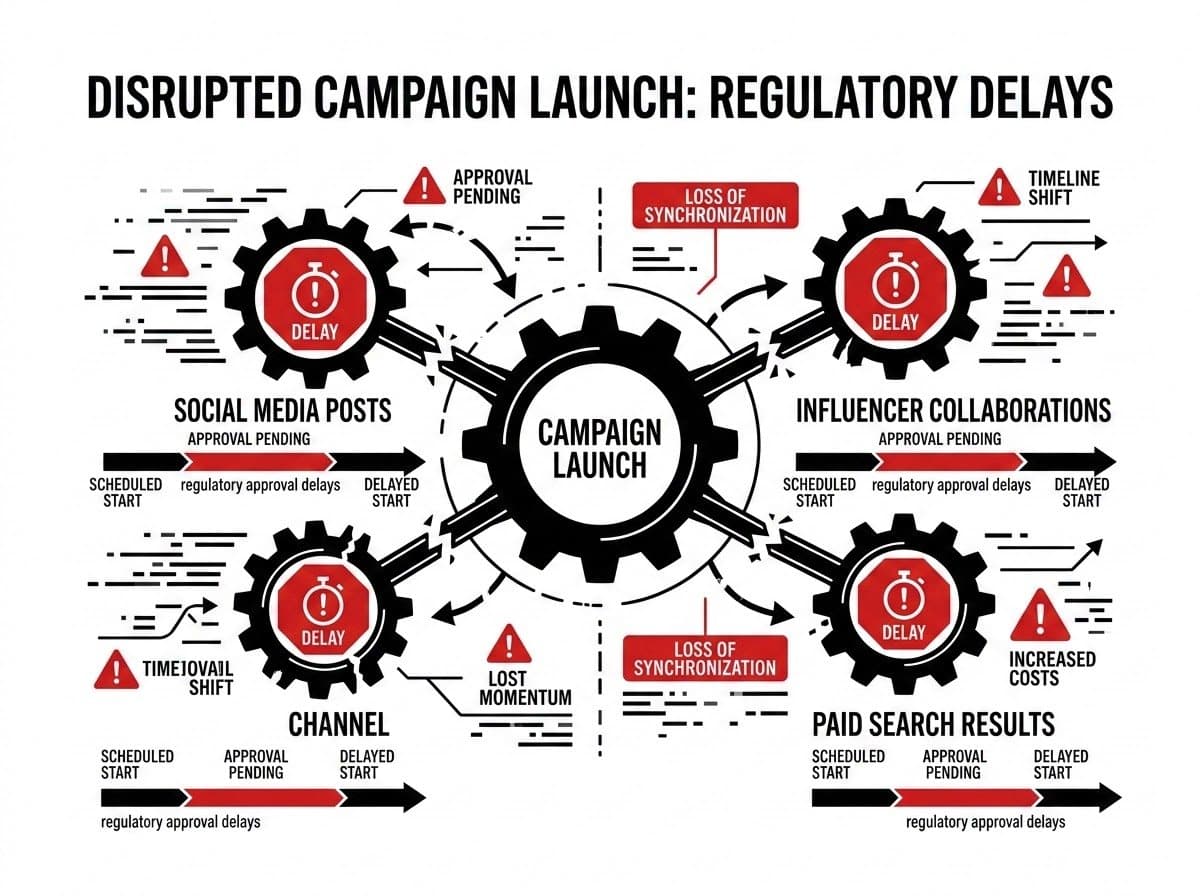
Time and money can usually be tracked, but campaign momentum is much harder to capture on a spreadsheet. A campaign does not begin when the final ad goes live. Momentum starts building much earlier through planning, internal communication, teaser content, influencer activity, public relations, social media, sales preparation, and audience anticipation. These activities are designed to work together, which means a delay in one important part of the campaign can affect everything around it.
Imagine an influencer campaign scheduled to begin on Monday. The influencers publish their content as planned, but the paid media campaign that was supposed to amplify those posts is still waiting for approval. The influencers have done their part, the audience has seen the content, but the brand cannot provide the planned level of amplification. The campaign has started, but it is not moving with the force that was originally planned.
The same thing can happen with a product launch. A brand may spend several days releasing teaser content designed to build anticipation before the main announcement. If the main campaign asset is delayed, those teasers may lose their purpose. Instead of creating anticipation that leads somewhere, they create anticipation that has nowhere to go. By the time the main campaign finally launches, some of the energy that made the moment valuable may have already disappeared.
This is why campaign timing matters so much. Marketing works partly because different activities reinforce one another. Social media creates awareness, paid media expands reach, influencers add credibility, PR creates conversation, and sales teams prepare to respond to demand. When the central creative is delayed, the coordination between these activities can weaken. The campaign may eventually launch, but it may no longer have the same impact as it would have had if everything had moved according to plan.
Why Are Ads Still Being Rejected?

It is important to recognise that repeated rejections do not necessarily mean marketing teams are careless. Most teams are working under pressure, managing deadlines, multiple stakeholders, changing briefs, production schedules, client expectations, and commercial targets. The bigger issue is often how compliance is built into the creative process.
Many teams still approach regulatory approval as something that happens after the creative has been completed. The process becomes: create the ad, get internal approval, submit it, and wait to see whether it passes. The problem is that this approach turns regulatory review into a discovery process. Instead of identifying potential issues before submission, the team discovers them during submission, after the creative has already been produced and resources have already been committed.
Advertising regulations can contain requirements around claims, language, disclosures, product presentation, messaging, and other aspects of advertising communication. Understanding a guideline in theory is one thing; applying it correctly to a specific piece of creative is another. A team can read the regulations and still overlook an issue in a headline, visual, product claim, disclaimer, or call to action. Then the ad gets rejected, and the team learns what needs to change only after it has already spent the time and money producing the asset.
Compliance Should Start Before Submission
A more efficient approach is to bring compliance into the creative process much earlier. Instead of asking, “Will this ad be approved?” after the work is finished, teams can ask, “What could prevent this ad from being approved?” while there is still time to make changes easily and without disrupting the wider campaign. That is the thinking behind Advetter.
Advetter is an AI-powered platform developed using ARCON’s advertising guidelines and brand book. It allows marketing teams to pre-check their advertising creative before submitting it for regulatory review. The idea is straightforward: upload the creative, allow Advetter to analyse it against the relevant guidelines, review the issues it identifies, and make the necessary changes before submission.
This changes the process from waiting for a rejection to identifying potential problems earlier. Instead of receiving feedback after the creative has already gone through production and submission, teams can use the pre-check to identify areas that may require attention while they still have control over the work. A process that once involved submitting, waiting, receiving feedback, and starting another round of revisions can become more proactive and predictable.
That does not mean every issue will disappear, and Advetter does not replace ARCON or guarantee regulatory approval. Final approval remains with the regulator. What Advetter does is help reduce avoidable uncertainty before submission, giving marketing teams another layer of confidence before they commit their work to the formal approval process.
From Reactive Corrections to Proactive Marketing
The bigger opportunity is not simply reducing the number of rejected ads. It is changing how teams think about compliance. Regulatory considerations should not be treated as a final obstacle standing between creative teams and the market. They can be considered alongside strategy, messaging, creative development, and production, so potential issues are identified while the work is still being developed rather than after it has been completed.
When compliance becomes part of the workflow, teams can spend less time repeating work, creative reviews can become more predictable, campaign timelines can be easier to manage, media plans can be protected, and launches can happen closer to their intended dates. More importantly, marketing teams can make decisions with more information before committing significant time and budget to production.
That is increasingly important in a digital environment where speed matters. Brands are competing for attention in real time, trends move quickly, consumer conversations change quickly, competitors can respond quickly, and campaign opportunities can appear and disappear within days. A regulatory rejection should not become an avoidable source of delay when teams have the opportunity to identify potential issues earlier.
The Real Question Is What a Rejection Causes
The real cost of a rejected ad is not simply the cost of fixing the ad itself. The bigger question is what that rejection causes across the rest of the campaign. It creates another round of creative work, which requires more time from the team. That additional work consumes resources, the delay affects the campaign schedule, and the schedule can affect media, influencers, social content, PR, and other activities. Eventually, those small disruptions can affect the moment the campaign was designed to capture.
This is why regulatory pre-checking deserves a place much earlier in the advertising workflow. The goal is not to remove creativity from the process or make teams afraid to take creative risks. It is to give them greater clarity before they commit to production and submission.
Good marketing should move quickly, but moving quickly does not mean skipping important checks. It means finding ways to make those checks earlier, faster, and more useful. For marketing teams operating under increasingly complex advertising requirements, that can make the difference between constantly correcting campaigns and confidently moving them towards launch.
If rejected ads have been quietly eating into your campaign timelines, budgets, and momentum, it may be time to look at what is happening before the next submission rather than after it.
Try Advetter today. It is free.
Get started free